Best Time to Visit Alanya for Your Travel Style
The best time to visit Alanya depends on what you want from the trip. Start with summer if beach time is the priority, compare spring and autumn if you prefer sightseeing without making very hot weather the default, or consider winter if mild conditions matter more and you can accept a greater need to plan around rain. Compare the travel windows before choosing exact dates.
Compare Alanya travel windows by your priority
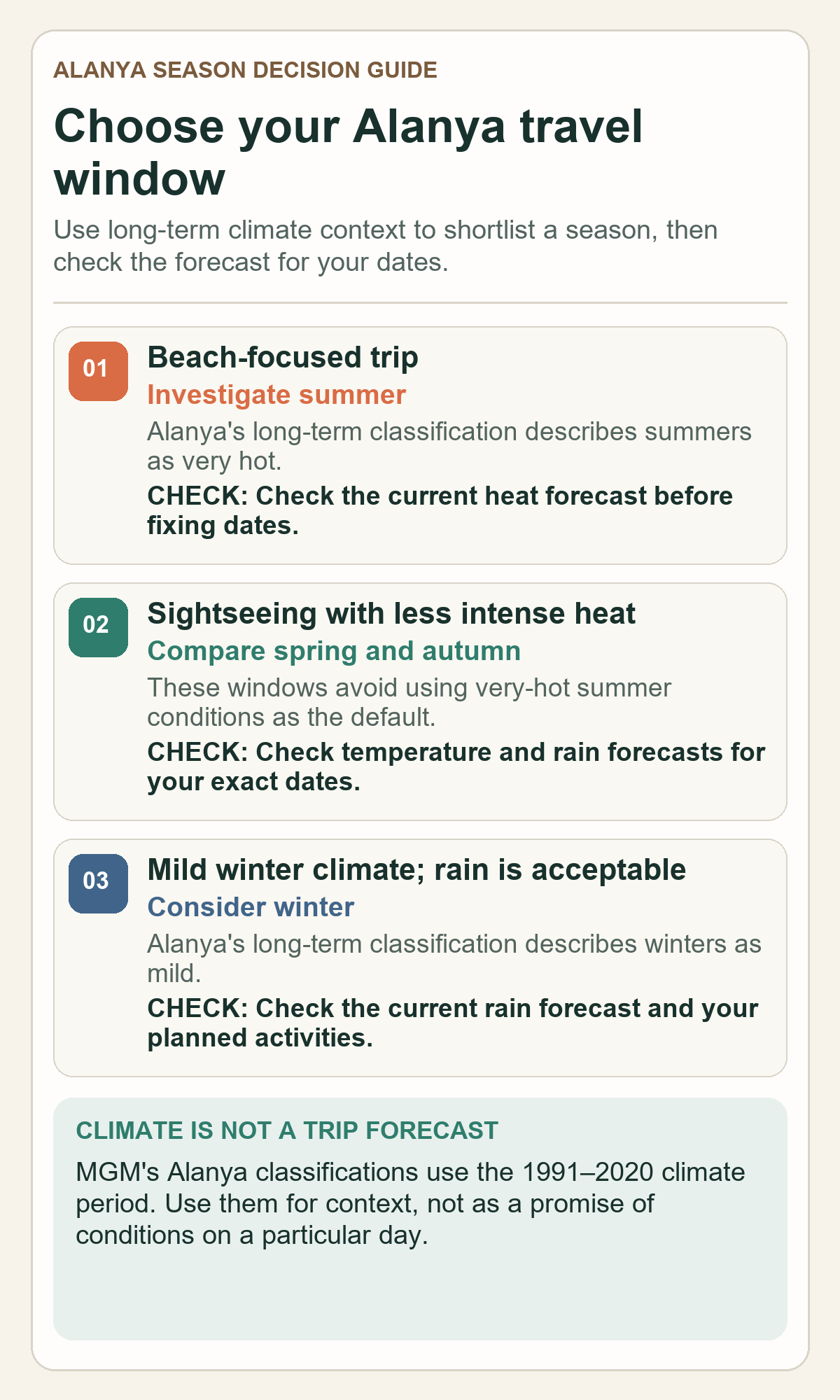
Use this matrix to shortlist one or two periods. It is a decision aid based on long-term climate context, not a promise about the weather during a particular stay.
| Priority | Period to investigate | Why it may fit | Trade-off | Check before choosing |
|---|---|---|---|---|
| Beach-focused trip | Summer | Summer is the clearest period to investigate when warm-weather plans lead the itinerary. | Alanya's long-term climate classification describes summer as very hot, so heat may limit time outdoors. | Check the current heat forecast and decide whether the expected conditions suit everyone in your group. |
| Sightseeing with less intense heat | Spring and autumn | These seasons let you compare dates without accepting very-hot summer conditions as the starting point. | Conditions vary by date, and a seasonal label cannot establish whether a particular day will be comfortable or dry. | Compare temperature and rain forecasts for the exact dates with the time you expect to spend outside. |
| Mild climate with rain tolerance | Winter | Alanya's long-term classification describes winter as mild, making it a period to investigate when beach weather is not the main requirement. | Mild does not mean dry, nor does it guarantee conditions for outdoor plans. | Check the rain forecast and make sure indoor alternatives fit the trip. |
What Alanya's long-term climate evidence can tell you
Alanya has a Mediterranean climate. That broad context is useful because it explains why the seasonal choices are meaningfully different, but it should be used to compare periods rather than predict individual travel days. The Republic of Türkiye Ministry of Culture and Tourism's Alanya brochure provides local context and a month-by-month table of daytime and nighttime air temperatures. Those figures describe a pattern; they are not a forecast for a future booking.
The Turkish State Meteorological Service, or MGM, publishes climate classifications for Alanya using the 1991–2020 climate period. Within that long-term classification, summers are described as very hot and winters as mild. These are the strongest supported criteria for separating the most heat-intensive option from the milder one. They do not establish sea conditions, rainfall totals for your dates, hotel demand, prices, or how crowded the destination will be.
This distinction matters when making a practical choice. A traveler who dislikes intense heat can reasonably move spring and autumn higher on the shortlist, while someone considering winter can use the mild classification as context. Neither decision proves that the selected week will be dry, cool, hot, or suitable for a particular outdoor activity.
Treat the long-term evidence as the first filter: use it to select a season that matches your tolerance and plans. Then use a current forecast close to departure to decide whether the actual temperature, rain outlook, and any warnings work for your itinerary.
Choose between spring, summer, autumn, and winter

Spring — compare comfort with rain uncertainty
Spring is worth comparing when your itinerary puts walking, sightseeing, or other outdoor activity ahead of maximizing exposure to summer heat. The Ministry brochure's monthly air-temperature context helps distinguish spring from the hotter part of the year, but it cannot tell you whether your chosen days will feel comfortable or stay dry.
Before settling on spring dates, list the activities that would be affected by rain or an unexpected warm spell. Check the current daily temperature and rain forecast against that list. If several plans require long periods outdoors, keep flexible timing or an indoor alternative rather than assuming the seasonal pattern will hold on every day.
Summer — prioritize heat tolerance before beach plans
Summer is the period to investigate first for a beach-led itinerary, but heat tolerance should decide whether it remains on the shortlist. MGM's long-term Alanya classification describes summers as very hot. That makes the expected heat burden a planning criterion, not a minor caveat after dates have already been chosen.
Consider how children, older travelers, or anyone sensitive to heat will manage the hours you plan to spend outside. Near departure, check the daily forecast and any heat warnings, then adjust the timing and duration of outdoor plans. The climate classification does not guarantee swimming conditions and provides no basis for claiming a particular sea temperature.
Autumn — compare lingering warmth with exact-date rain risk
Autumn provides a second comparison window for travelers who do not want very-hot summer conditions to define the trip. The approved monthly air-temperature context can help you compare earlier and later autumn dates, while the long-term classification keeps the recommendation grounded in seasonal differences rather than promotional claims.
The practical test is still date-specific. Check both temperature and rain forecasts for the planned week and relate them to the itinerary. An outdoor-heavy trip needs a different tolerance for uncertain conditions than a trip with flexible or indoor activities. Do not assume that the same autumn description applies equally to every month or day.
Winter — choose mild climate only if rain fits the trip
Winter may suit a traveler whose main criterion is a mild climate rather than a beach-focused schedule. MGM's classification supports the word “mild” as long-term context, but mild is not another word for sunny, dry, or suitable for swimming. It also says nothing about prices or how busy particular places will be.
Make rain tolerance the deciding test. Identify which planned activities require dry weather, check the current forecast for the actual dates, and prepare alternatives for the most weather-sensitive parts of the itinerary. Winter stays on the shortlist only when that level of flexibility still produces the trip you want.
Check these details before you fix your dates
Complete these checks after choosing a preferred season and before treating the dates as settled:
- Review a current daily forecast for the exact travel window; do not substitute a climate average for expected conditions.
- Check whether forecast temperatures fit every traveler's heat tolerance, especially if the itinerary involves long periods outdoors.
- Look at the rain forecast and identify which activities would need rescheduling or an indoor alternative.
- Check official warnings close to departure and adjust the timing of exposed outdoor plans when necessary.
- Match packing choices to the current forecast rather than relying only on the season's usual description.
- Recheck the forecast shortly before travel, because a decision made from long-term climate context still needs current information.
The useful decision is not simply “summer or winter.” It is whether the forecast for your chosen dates supports the activities, comfort limits, and flexibility that shaped your shortlist.